The Big Night
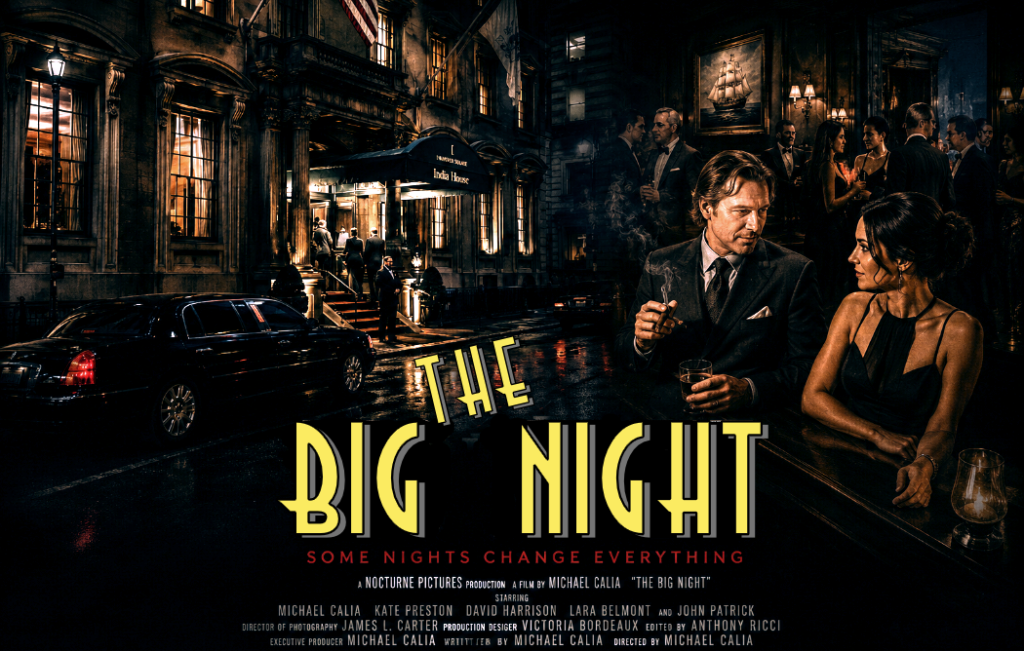
Grand Central terminal, 9:15 p.m., April 25th 1998
I was one of them.
I walked briskly into the main concourse of Grand Central, which was lightly populated, the rush hour commuters having been safely whisked away to their affluent enclaves, where they would depart early Monday morning. The sound of footsteps reverberated amid the ornate marble interior which had become so familiar to me.
I was one of those people walking as quickly as possible through the concourse toward some urgent destination, some important meeting. My haste contributed to the frenetic energy typical of Manhattan. Usually when I was arriving, I was not in a rush; I would make my way toward the subways or 42nd Street.
But not tonight.
I was wearing a navy blue double-breasted suit jacket with matching slacks, dress shirt and tie, with leather dress shoes. I looked good. No one need ever know that I had pieced together this suit from a Salvation Army thrift store and was the only suit I owned.
On my shoulder was a camera bag crammed for the evening ahead, filled with two flashes, my Minolta x700 and x370 body with a 50mm lens, and ten rolls of premium film. Steve Gilbert’s deep baritone voice reverberated in my head as I made my way towards a line of taxis at Lexington avenue: My friend at the Manhattan yacht club needs someone to shoot pictures of their award ceremony; they’re having a regatta on Saturday and I can’t do it, so if you want the job it’s yours. Gilbert was a friend of Jeff’s, who had clued me into the job.
I scaled the marble staircase that led to Lexington Avenue and the covered area where taxis queued for fares. As the person ahead of me climbed in, the next taxi pulled up. I climbed in saying “One Hanover Square.” As the Indian driver set the meter, I received the recorded warning from Joe Torres to buckle up and we were off.
One Hanover Square was the address for a place called the India House, located in the heart of the financial district, which was at the tip of Manhattan. The driver, whose daughter was in the front seat, maneuvered the taxi through the dark city streets, heading towards the FDR Expressway. I settled into the relatively new crown Victoria and tried to relax. My housemate Dan had driven me to the Port Chester station so I could leave my car in the driveway.
“The people who will be there make in a day what I make in a year,” I told him.
Dan said in his typically quiet tone, “Well just because they make more money doesn’t mean they’re better.” Words of encouragement.
On the FDR, the cab raced south at a refreshing clip. On my right, faceless buildings flashed by offering staccato glimpses of the city lights beyond. On the left was the dark, brooding waters of the East River. Beyond, the lights of Brooklyn warehouses and apartment buildings were softened by a Gothic ominous fog.
The streets criss-crossing through the financial district were abandoned. Once the day’s trading ended and the denizens of the financial kingdom fled to Grand Central and Penn Station, this part of Manhattan became a ghost town.
The driver didn’t know where Hanover Square was, and rather than pay him to figure it out, I ordered him to let me out at the head of Wall Street. Joe Torres’s recorded voice reminded me not to forget my personal belongings and the driver lobbed an apology from his open window as he drove away along Church Street and out of sight.
Silence descended.
Tall omnipotent buildings rose up into the fog shrouded darkness. No cars were in sight. Down the narrow, almost alley-like Wall Street, which had been barricaded for the evening, was the prestigious New York Stock Exchange, nestled snugly amid taller more imposing buildings, like architectural bodyguards. The sidewalks were deserted, and even sounds of traffic were absent. The only other human being in sight was a lone suit-wearing man at the barricade that sealed off Wall Street leading to Church Street where I now stood. He was a silhouette, a void in the fabric of reality.

I walked along the sidewalk shrouded in darkness. Dimly, I thought it ironic that one of the most famous streets in the world should be a narrow one-way lane, almost as if it had been an afterthought. The only sounds were the echoing footballs of my dress shoes.
A man standing at the second barricade was a suit-wearing security guard. He was black, with a receiver wire leading from his ear. He pulled it out as I asked him where Hanover Square was.
“The best thing for you to do is to go down Broad Street here and take your second left. That will get you to Hanover Square.”
A pole mounted streetlight cast us both in a pool of bright white light, like we were two actors on some grand stage. I felt like that. It felt like I had stumbled into the lead part of a play for which I knew none of the dialogue, but the players continued with their performances anyway.
I left the guard behind and walked south on Broad Street, past fortresses of marble, concrete and steel, one side lined with cars but still no traffic, and no sounds. No horn honking, no distant whooping of a siren, no voices. On the empty, black street a manhole cover was releasing a furious horizontal geyser of steam horizontally over the asphalt, snatched by an invisible wind.
I turned at the second light, feeling like the last person left alive in the city, up a dark curving street lined with shuttered Chinese shops and restaurants, newspaper stores and gift shops, all securely locked up for the night. I passed the curbing facade of Delmonico’s, with its inset letters above the welcoming double doors and I stopped to study it, grinning. Delmonico’s was a Manhattan institution going back to the mid 1800s. Delmonico’s was also popularized in Caleb Carr’s excellent 1897-era murder mystery The Alienist.
One Hanover Square was dead ahead, with shiny Lincoln Town cars pulling up and gliding away in silence. Couples in fancy dress filed inside, where they would spend the evening snapping expensive lighters at each other and discussing whatever it was that wealthy debutants discussed. The building was old, with a stone facade and granite window ledges. The large green awning which covered the wide carpeted stairway announced that this was the India House. A well-dressed, barrel-chested man stood at the foot of the stairs, watching affluent couples file inside and keeping a sharp eye out for riffraff.

The line led through an ornate set of double doors to an entrance area lined on both sides with tables where tickets were being checked and coats were being taken. Dozens of excited conversations filled the place with noise. The white walls led to a broad, carpeted stairway that went up to the next floor in two directions. Beside the stairway was an enormous, brass bell.
Amid the crush of people, I called to a tuxedo-wearing man in his sixties, gaunt with white hair who seemed official. “Excuse me, I’m looking for Bill Hefner.”
“Oh he’s at the registration table behind me,” tuxedo answered. I moved forward to where several people sat behind a long table covered with a white linen tablecloth. They were distributing tickets; one woman in her 40s claimed she had never received hers in the mail and was becoming quite agitated about it.
“Mr Hefner?” I called above the noise of the crowd. A trim and gentleman in his ’60s stood up. Wearing a tuxedo of course. He actually resembled Hugh Hefner; maybe he was related.
“Yes?”
“I’m the photographer for the evening.”
“Oh yes, hi!”
“Is the commodore here?”
“Yes he’s here somewhere. He didn’t give me a list of shots that he wanted. The best thing to do is take pictures of people having a good time. And if you see things like women sitting on men’s laps, try to get that too.”
People swarmed around me, jostling for space. I leaned forward. “As I mentioned to you earlier, the more information you can give me about what you’re looking for, the better results you’re going to get.”
Heffner looked slightly puzzled. “We just want to show people having a good time. That’s the main thing.”
The crowd was getting thicker, so I nodded and moved on, up the ordinate staircase to the next floor, which was more dimly lit. There were dozens of well-dressed couples sipping drinks while stewards brought around silver trays with hors d’oeuvres. The second floor had a broad main area lined with overstuffed leather couches and doorways leading to other rooms. The carpet was burgundy, and the aqua walls were adorned with paintings in fancy wooden frames of schooners with billowing sails, whaling boats in rough seas and majestic galleons. An ornate wooden balcony railing on the third floor overlooked it all; couples leaned on the railing looking down at the people milling around below. A model sailing ship was suspended in the middle of the opening. The India House had once belonged to a wealthy whaling captain from the 1700s and was now used for high class functions.

I heard someone calling my name as I wandered around. I turned and a woman came up to me. ” Are you Mike? The photographer? “
“Guilty as charged,”
“”My name is Kim.” We shook hands. Kim was a little taller than me with a medium build concealed by a flowery gown that flowed in straight lines to her feet. I had spoken with her on the phone in preparation for the job.
“Is the commodore here? I’d like to talk to him about what kind of pictures he’s looking for. I understand there’s an award ceremony. Do you know when that takes place?”
“No, but maybe we can find him.”
I unbuttoned my double breasted blazer and followed her around the corner to a large open area where more people were congregated, wandering through the Heineken Amstel room, where there were old overstuffed leather sofas, blood red walls, and two tables behind from which Heineken and Amstel were being served, with an enormous parchment colored globe sitting in an ornate wooden cradle. The walls had more antique sailing paintings.
I followed Kim back out to the entrance of the second floor where a set of stairs led up to the landing, where there were more stairs on either side leading up to the third floor. Above this entrance was a large wooden flying lady, a figurehead of the type that was once used to adorn the bows of ocean going schooners. The carved lady looked up to the ceiling like a martyr praying for relief from the captors who had hung her there. One rich yuppie on his way down the stairs said in an excited voice, “Oh no the ship’s tilting! I think we’ve struck an iceberg!“ Behind him his date rolled her eyes.
At the top of the narrow staircase was a large room crammed with people sipping cocktails. Over the din of dozens of conversations a band at one end was playing Dixieland jazz and there were some couples dancing on the hardwood floor. The room was so crowded it was impossible to move about, and Kim and I parted. I began to wander around, taking pictures.
I took pictures of men in their tuxedos smoking cigars on the balcony above, pictures of elegant women in alluring cocktail dresses with spaghetti straps, and pictures of people trying to have a good time. Most of the affluent members in attendance looked vaguely bored. After spending a whole day on handmade racing sailing boats, perhaps they felt that the awards evening was obligatory, an official duty they felt obligated to attend. Maybe they had not yet shed their sea legs.
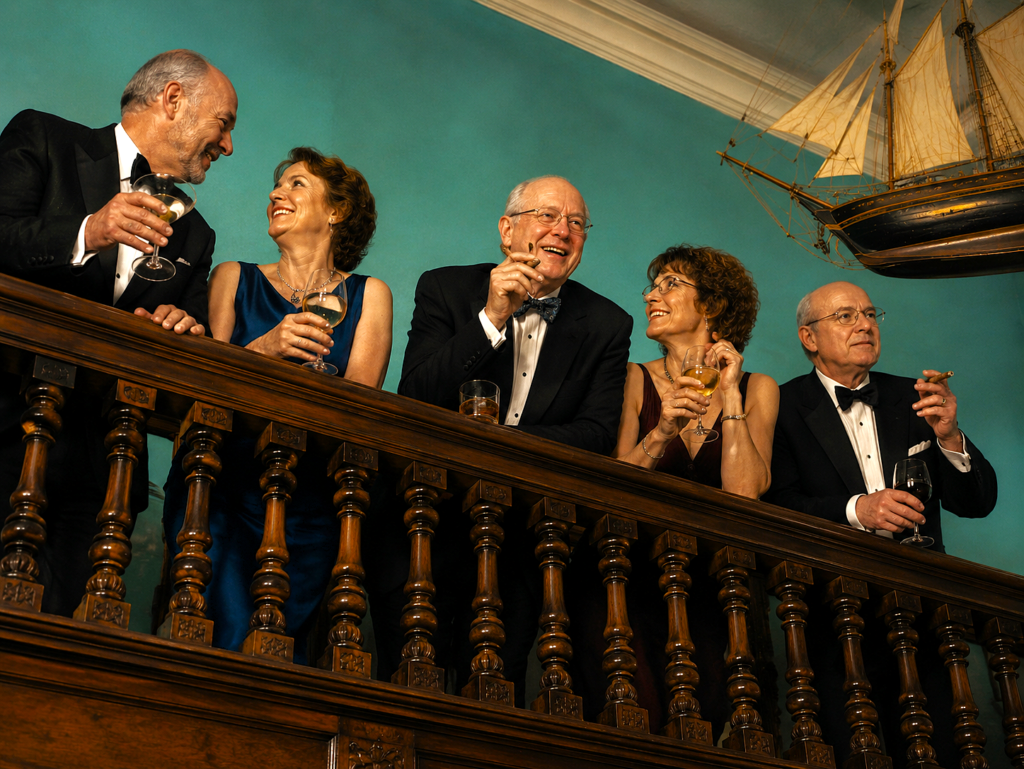
A woman came up to me and asked if I would take a picture of a group of hers. We went into the Heineken Amstel room where I positioned them on a sofa and snapped a couple of pictures.
“So are you the official photographer of the evening?” one of the men in the group asked me. He was a jovial, round-faced bloke wearing a tux with a comma of hair that fell over a broad slab of pink forehead.
I nodded. “Freelance. I was asked at the last minute by the commodore. What do you do?”
“Me? Oh I just go from party to party,” he answered and the group laughed.
“That sounds like a pretty good gig,” I answered.
“That’s how I met these guys. I crashed the reception,” he said to another man in the small group, who immediately answered with a laugh, “And I’ve been miserable ever since.” There was another burst of laughter from the group.
I pulled out one of my business cards from the inner pocket of my blazer and handed it to him.
“Besides photography I also do caricatures.”
“Oh really! Well I’m a caricature myself. Could you draw me?”
“I can draw anybody. I just finished a job for a client; thirteen people in this particular piece. They’re going to send it to Florida where my clients’ family reunion is located.”
The humorous man beamed. “Well I’ll definitely keep this in mind!”
In the corner of the large room on the second floor, behind a solitary microphone stand, was a table on which a collection of expensive looking Statue of Liberty trophies sat. The commodore stepped behind the microphone and began to get the attention of the assembled guests, who congregated like a blood clot, spilling out into the hallway outside the room. I was at the front, taking pictures. After he got the audience’s attention he thanked everyone for coming and advised them to have fun before 1:30, when the party would end. The commodore was surprisingly young, a boyish man in his mid-thirties, with round spectacles that gave him an intellectual appearance. He looked like he would be right at home wearing suspenders and sitting in a Wall Street office watching stock numbers on a video screen.
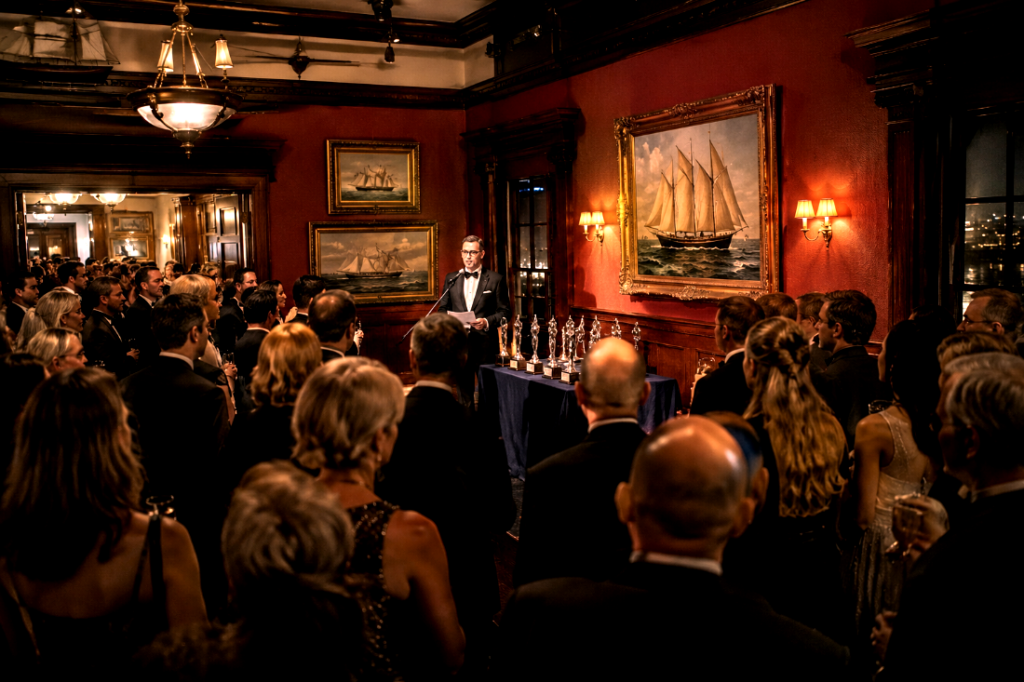
One by one, the commodore presented the awards for the sailing regatta that had taken place earlier today, starting with a thin woman with close cropped hair who represented a champagne company that had helped sponsor the event; every room in the place was sponsored by a different liquor company. Next came the winners of the first, second and third place boats, all of them female crew members. Point and shoot cameras twinkled. After the awards were given out, the crowd began to break up and drift to other parts of the large house.
From the third floor, I looked down at the rich and beautiful people who milled around below, members of a select club of which I was not a member, nor would I ever be. I wondered what it was like to have that kind of money. Was life more enjoyable when almost everything you wanted was within reach, or was it just more complicated, especially with all the yes persons who agreed with everything you said even while they were figuring out how to get above you on the power ladder?
I wandered into the Nat Sherman cigar room, which was brightly lit, with aqua colored walls and an ornate marble fireplace, cleaned out and no longer in use. A wooden bar was wedged diagonally into one corner, while at the back was a table with a wood and glass display case filled with cigars. Wooden matches littered the area in front of it. There were two smaller tables of white marble in the other corner.
The room was not too crowded; two tuxedoed guys were lighting each other’s cigars with an obvious lack of experience. Two women were puffing on slim, brown cigars that looked like cigarettes. This was the kind of place where contacts were made and deals were struck. Cigar rooms were havens from the exposure of the everyday world, a place to laugh with a friend, reminisce, or plot strategy.

The air was faintly obscured with smoke. A bushy white-haired man with oversized black framed glasses came up to me. He looked like Andy Warhol. I wondered if, like Bill Hefner, this was Andy’s brother, in the sense that they were relatives of celebrities present tonight.
“Do you like cigars?” he asked me in a used car salesman voice. I told him I did. ” Well! ” he exclaimed, clapping his hands together. “What kind of cigars do you like? Medium, bodied full-bodied, mild?”
Now he reminded me of the rabbit in Alice in Wonderland who wore the oversized top hat. “Medium.”
“Well! You should try some of the Nat Sherman select cigars right over here! ” He rattled off a list of cigars at me.
I indicated my cameras. “I’m working at the moment, but when I run out of film I’m going to come back and take you up on that.”
This seemed to satisfy the odd looking man, who wandered away. I found myself taking a couple of pictures of a young woman behind the bar in the corner. She was younger than me, but adult enough. Her prominent cheekbones kept in place two smiling eyes accented with makeup. She had a perfectly proportioned nose, the right amount of rouge on her cheeks and blood red lipstick. Dark brown hair was secured on her head but a few strands managed to find their way down to a bare shoulders. The black cocktail dress had danger written all over it, barely covering her breasts, with a panel in the middle reaching up to conceal the cleavage. She had a lithe body with small, feminine hands.
“Would you like a copy of the picture?” I asked, stepping up to the bar .
“I’d love a copy,” she answered enthusiastically. “Here, let me give you my card.” She handed me a Nat Sherman business card with her name on it, Alex Stein. She was smoking a thin brown cigar which looked like a cigarette.
“How long have you been working at Nat Sherman’s?”
“About 2 years,”
“You must like cigars.”
She nodded amicably. “I smoke them occasionally.”
“Have you ever heard of Don Tomas cigars?”
“I’ve heard of them but I’ve never tried one. What kind of cigars do you like?”
“What do you have in a good medium bodied smoke?”
Alex consulted a menu in a stand-up lucite frame which had a listing of select Nat Shermans. “I would recommend a number 711.”
“When I run out of film I’m going to come back and try one. I’m always up for discovering a new cigar. How long have you lived in Manhattan?”
Alex leaned forward as if she was hoping no one else would hear. “I’m originally from Long Island, but I’ve been living in Manhattan for a couple of years.”
I grinned. “I won’t tell anyone. I don’t think I could live in Manhattan. The pace is too hectic for me.”
Alex laughed; it had a musical sound. “Yes, you do have to be kind of nutty to live here that is for sure.”
“I come down here quite often,” I said. “Maybe you could show me some out of the way spots in Manhattan that most people aren’t aware of. Have you ever done any modeling?”
Alex laughed and a slightly bashful fashion. “A little. I don’t do it that much anymore.”
“You should, you’re a natural.” I handed her my business card and left the cigar room.
As I wandered around, I plucked finger sandwiches from silver trays being carried around by white coated attendants. Everyone was milling around, holding drinks and chatting, but no one seemed to be having a really wonderful time. Even in the large room where the live band was playing jazz, the couples that were dancing seemed to be doing so by the numbers, as if they’d already had enough of each other.
On the second floor, I had a seat on one of the leather sofas that lined the walls with the balcony above line with people smoking cigars and sipping drinks. Beside me were two women in their late ’30s, one a vivacious brunette who looked like she was pushing forty hard enough to break a wrist, the other a smiling, slightly heavy set blonde. The two of them were talking jovially as I fell into the obscenely comfortable sofa. I set my cameras on my lap and greeted them pleasantly.
“Do you think people here are having good time tonight?” the brunette asked me, leaning over so I could hear.
“Some seem like they’re here because they have to be. There doesn’t seem to be any chemistry in the air.”
“That’s it!” Brunette exclaimed. “There’s no chemistry. People don’t seem like they’re enjoying themselves .”
“Why do you suppose that is?”
The blonde answered, “I think it’s because there are too many areas for people to be. There’s no focal point for people to mingle.”
“Something else I noticed,” Brunette added, “the people here tonight are sticking with the people they know. They’re not meeting new people.”
“Well that doesn’t make much sense,” I answered. “What’s the point of coming to an event like this if you’re not going to meet new people?”
“Exactly! The men and women aren’t mixing. The men are all grouped in one place and the women in another.”
I shook my head. “This is a perfect occasion to meet people. Everyday is precious. Even when there have been times when I didn’t have two nickels to rub together-”
“Doesn’t make any difference,” Brunette injected firmly.
“That’s right, even when my bank account was thinner than the gold on a Las Vegas wedding ring I would go down to the river to watch the sunset. Anything that increases the quality of life.”
The blonde indicated the gold ring on my finger with the Cross of Lorraine on it. “I noticed your ring.”
I held up my hand. “It’s my unit ring, from when I was in the service.”
“What did you do?”
“I was in a howitzer battalion, forty-five kilometers from the East German border.”
“And now you’re a civilian.” The blonde said. “Good for you !”
“Well, I really didn’t want to leave. My injury forced me out. In retrospect, I guess I can’t really complain.”
We chatted a bit longer before I got up and bid them a friendly farewell.
I was beginning to run out of things to take pictures of; how many shots of people standing around trying to look like they’re having a good time could you get? The place was filled with extremely beautiful women, a good portion of which were no doubt single. Women that beautiful intimidated me; I had a hard time imagining a woman that gorgeous being satisfied with someone rather ordinary looking like myself, when she could have any man she wanted. And when you introduced a higher income than me, forget it. What was the old saying? No money, no honey.
After grabbing a Heineken from the Heineken Amstel room I went into the Nat Sherman room where Alex was still behind the wooden bar in the corner. It was around 11:15 and after taking all the shots I needed, it was time to relax.
“Alex, let’s try that cigar.” I announced. She brightened and led me over to the glass cigar case, telling the tuxedoed man behind it to give me a number 711. I paid him, and Alex clipped the end for me.
“Do you want me to light it for you?” she asked.
I produced my 65th anniversary Zippo lighter. “I’ve got that covered.”
“You should light it with wooden matches,” Alex suggested. “The butane in Zippos leaves a chemical residue on the outer wrapper.”
“I doubt my pallette is sensitive enough to notice a difference,” I answered, but she had struck a couple of matches and held them out. I dipped my head and carefully rotated the cigar as I puffed, producing clouds of smoke that drifted upward. When it was good and lit I took a big draw and exhaled through my mouth and nose sampling the flavor.
“Not bad,” I announced.
“Do you like it?” Alex asked.
“I do. It has a nice flavor.”
“Well, sit down and enjoy it,” she responded with a smile indicating the two tables in the corner. I went into executive session with my beer and cigar, feeling like I had millions in the bank.
A strawberry blonde haired woman with a round face and slightly sleepy eyes stood beside me holding a book of raffle tickets. She sized me up as I worked on my second glass of Heineken, exhaling smoke skyward, thinking thoughts.

“You look loaded,” she said to me.
I turned to look at her, surprised. I was only on my second beer. “Excuse me?”
She nodded, smiling confidently. “Yes, you look like you have a lot of money.”
I grinned. “I do huh?”
“I know the type. You probably got pockets filled with money, organized in different denominations.”
I studied her as I took another draw of my cigar, blowing smoke. “You seem pretty sure about that,”
“I know the type, and you’re definitely it.”
I took a long extravagant pull of cigar, and savored it as I exhaled before responding, “Well, my Ferrari is parked outside. If you want I’ll take you for a ride.”
Her eyes lit up like a Vegas slot machine. “You have a Ferrari?”
I shrugged elaborately. “Sure. I was going to take a cab down here, but it was such a nice evening I decided to take the Ferrari instead.” I had a sip of beer and added, “If you’re nice, I’ll give you a ride.”
She looked at me with apprehensive interest. “If I’m nice? What do I have to do?”
I smiled. “Just be nice.”
She looked down in wonder. “I’ve never ridden in a Ferrari before.”
“You haven’t?”
“No, but I’ve always wanted to. I’ve ridden in a Mercedes but I haven’t made it up to the Porsche or Ferrari level. What kind is it?”
“It’s a 308 GTB. I picked it up at Miller Motor Cars in Greenwich. I got tired of the BMW I was driving and decided I needed something with a little bit more pizzazz. So I splurged.”
“So what is it like, owning a Ferrari?” She was thoroughly engaged now and interested in me in a way that went beyond selling raffle tickets.
I looked reflectively off to the side, taking a long puff of cigar. “Have you ever seen 2001 A Space Odyssey, when Dave Bowman goes through that vortex? Every time I run it up through the gears it feels just like that.” Inwardly I marveled at my capacity for so effortlessly spinning such a wonderful load of crap.
“I’ve never seen that movie,” she said regretfully .
“Well let me just say that driving a Ferrari is a whole new level of reality. There’s not another car in the world built quite like it.”
“So where is it?”
“Right outside,” I answered off-handedly. “I have someone keeping an eye on it for me.”
“So when can we go for a ride?”
“I have to take some more pictures for the commodore then we can go. The streets are nice and quiet: it’s a good night for a drive.”
She was really interested now. “What color is it?”
“Ferrari red of course.”
She looked at me for several moments and then doubt spread on her face. “You don’t really have a Ferrari, do you?”
I took another puff of cigar and after exhaling smoke I said casually, “No,”
A smile spread across her face. “You’re good. You’re pretty good, you had me going. I like that.”
“I wish I had one. Does that count?”
She laughed. “I like your style. You still look like you have a lot of money.”
“Well thank you. I’m working on it.”
The granite-browed doorman in the tuxedo was still standing at the base of the steps under the India House’s awning, watching shiny Lincoln Town cars pull up, collect their affluent cargo, and depart. I paused beside him, the remainder of my cigar still corked in my mouth, savoring the damp coolness of the evening. Above us, the glowering city rose up into the night, the tops of the buildings hidden by darkness. The street was almost empty; two well-dressed couples passed us and climbed into a taxi.
I took another luxurious puff of smoke and let it drift up into the fog drenched night. “Where would I hail a cab around here?” I asked the door attendant.
He glanced at me incuriously. “At the curb at the end of the street,” he grunted.
I nodded and walked away from the India House. It was almost 1:00 a.m.; the last train from Grand Central left at 1:30. If I was lucky, I would just make it.
At the corner of Water Street the traffic was almost non-existent. Several other affluent couples lingered on the other side waiting for a cab. I stood at the corner of the dark intersection, and after several minutes a Honda Accord minivan taxi pulled up and I climbed in, ditching what was left of my cigar. Over the low tones of ethnic music I said to the driver, “Grand Central. And I need to get there before 1:30. Think you can swing that?”
The short, black driver said in a gregarious voice, heavily accented, “Heyyyyyy! Dere is no problem! If you miss your train, I take you to Westchester!”
I imagine I looked vaguely amused. “Well, Metro-North can get me there cheaper. “
“For you, I give special rate! Fifty dollars!” The driver gestured enthusiastically.
“Metro-North can do it for five.”
The driver laughed good-naturedly. “I get you there. I won’t make you miss your train. Today’s your lucky day! You are lucky man! Lucky, lucky man!” He laughed again.
I settled back in the comfortable confines of the minivan. “Seems that way,” I answered, and watched the black silhouettes of Brooklyn hide in the fog, defined by hazy points of light.
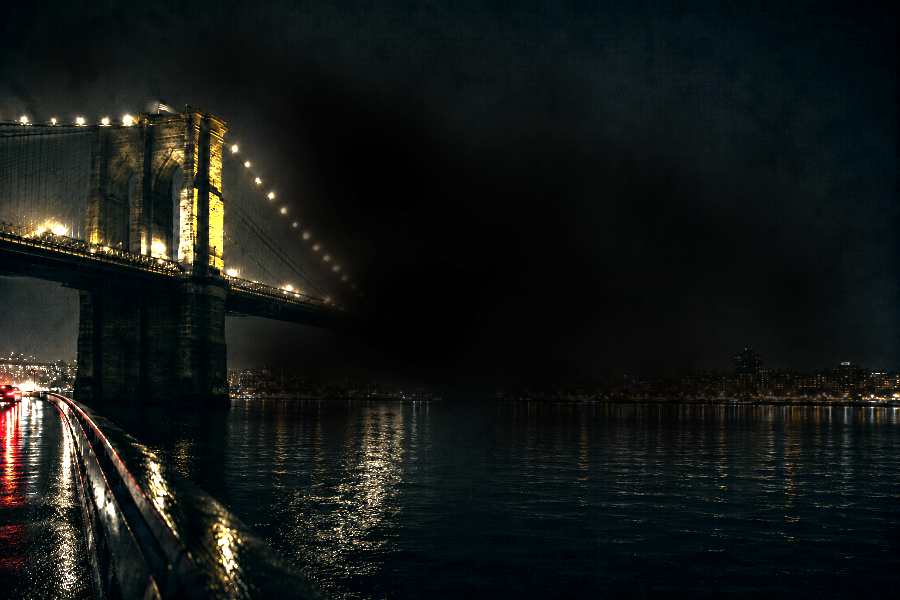
As we sped up the expressway lining the East River, an amazing site appeared. The gothic span of the Brooklyn Bridge, looking medieval and archaic at night, lit up by spotlights, vanished halfway over the East River, as if it had been cleaved in half, the other end taken away. If you were to walk across the bridge, you would vanish from this reality into an alternate one. There was no bridge reaching the other side of the river, nothing but darkness. I sat forward as the scene rushed by and just like that it was gone. For years later it would be the picture that got away.
“So what was going on back there?” The cab driver asked as he drove.
“An awards night for the Manhattan Yacht Club. They had a regatta today.”
The cabbie whistled. “Lot of money, dere, man!”
“You’re not kidding.”
“What kind of boat you own?”
“I don’t. I was hired to photograph the event.”
The cabbie laughed, happy with life. “Ahh! You take pictures of de rich people!”
“When I’m lucky. Say, is this Jamaican music?”
“No, no, no, man! This is music from Haiti. That’s where I’m from.”
“Yeah? How long have you been up here?”
“Two years. I have family in Haiti. I send them money.”
On a cab driver’s salary, that must not be very much, I thought. Driving a cab didn’t pay as much as it used to; it had become a sweatshop on wheels and the situation was getting worse, from what I had read.
We glided past the darkened windows of the Hyatt Regency on the corner of 42nd and Lexington, stopping in front of Grand Central Terminal. It was 1:15 a.m.; I had 15 minutes to make the last train home.
“Here we are, man, just like I promised!” the driver trumpeted.
“Very impressive,” I beamed, and handed him the money. “Keep the change.”
“Wooo, you give me big tip here, thank you very much! Anytime you need a cab, I’m your man! I’m your lucky cab!”
“Send it to your family in Haiti.” I said with a grin. “They deserve it.”
I stepped out before he could answer and ducked through the well worn wooden doorway, guarded by two cops who were due to close the place at 1:30, after the last train departed.
Grand Central closed for several hours between 1:30 and 3:30. Lining the empty marble corridor leading to the Grand Concourse were homeless people sleeping on cardboard beds. I walked across the nearly deserted expanse of the concourse, as if I was the last person left alive and bought a ticket at the vending machine and headed for track 32, back home to Port Chester.
Back to reality.