Canyon of Heroes

4:00 a.m.
Ossining was sound asleep in the chilled October morning, with the sun having hours to make its appearance. The traffic light hanging limply at the intersection blinked yellow mutely, with no car to heed its signal. The corners where buildings met sidewalks were cluttered with a washed up tide of dead, brittle leaves, scuttling around frantically at the insistence of the bitter wind. It was October 29th 1996, just days before the start of November.

The train station at the bottom of the hill was nearly deserted with the exception of a woman who tried to hand me religious pamphlets. She sat in her car by the stairs that led down to the train platform, watching me.
I didn’t care.
I squatted by the bales of newspapers and undid one bale, taking a New York Times and leaving sixty cents. The wind was cruel this dark morning, and I waited for the 5:05 train in the harsh brightness of the train platform shelter, sitting on cold cement. I was not dressed for cold weather; I was wearing my faded jeans, safari jacket and safari shirt underneath. These were my photo shoot clothes, much like Harriet and her spy clothes from Harriet the Spy. Beside me was my camera bag that carried all of my gear.
A sullen, orange zone was just showing on horizon as the train rumbled between the rundown buildings lining 125th Street. When the train finally came to a halt after passing through the dark tunnels beneath the city, I followed the crowd up the platform and into the main concourse of Grand Central.
Coffee. I needed coffee.
The enticing, pungent aroma of cinnamon buns filled my nostrils as I went up the marble incline to the miniature food court set up inside the terminal. After grabbing a large coffee I headed for the subway.
City Hall, a historically prestigious looking building with tall marble columns, sat before a thin jetty of grass and several trees called, appropriately enough, City Hall Park. The park divided Broadway into a Y, with Broadway continuing North, and Park Row winding around and meeting the busy Bowery, which headed north also. It was here where One Police Plaza was located.
Park Row was jammed with television trucks and vans, surrounded by crews uncoiling cables, making connections, standing around nursing cups of coffee. The early morning fog that lingered in my mind obscured the details, and the music of Vangelis’s soft mantra Morning Papers added a comforting auditory backdrop. The sun had not risen above the tall buildings and wouldn’t for several more hours yet; it was just 6:15 now and in the morning shadows a persistent chill had not lifted.
Blue police sawhorse barricades fenced off the park and empty faced police officers stood around lamely, with no traffic or crowds to direct yet. They would have more than enough to do later on, however.
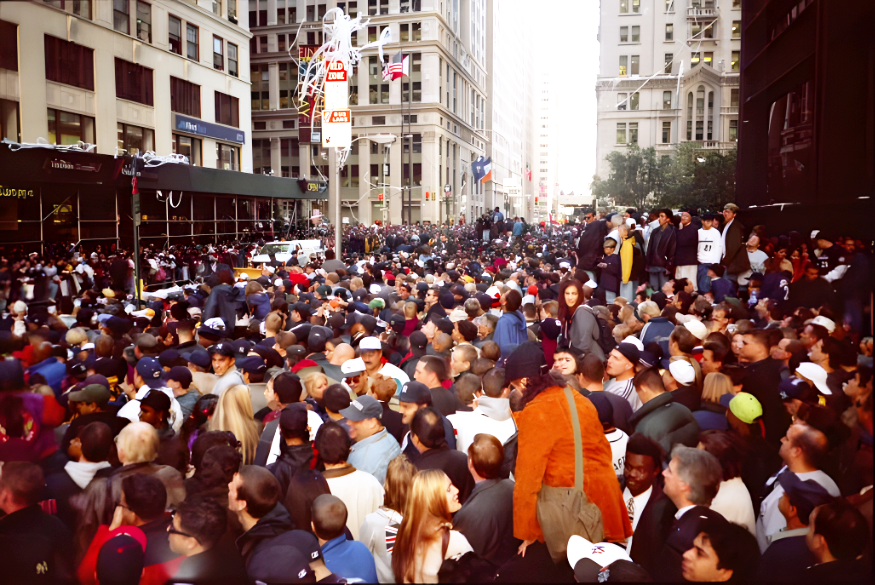
I cut onto Broadway, which was entirely lined with barricades. People were shuffling up and down the sidewalks and police cars were cruising importantly, blue lights flashing. People were already camped out along the barricades in clumps, like washed up seaweed. They sat on blankets and were bundled up against the cold. At the doorways to the tall office buildings were large bags of shredded paper, ready to be lugged up to the offices where they would be tossed out the windows. Large paper recycling and paper shredding trucks were making various stops, depositing more paper, jockeying for space with taxi cabs and delivery trucks. Amid this were city rat racers in their suits and ties, on their way to work. By 10:30 this morning, Broadway would be completely impassable, jammed with people except for the narrow river of space preserved for the parade route.
At the corner of Broadway and Cortland, a narrow side street, was a towering, dark-faced building at the foot of which was an open arcade area that fronted Broadway. It was fairly open, with good views both up and down Broadway, known as the Canyon of Heroes for its steep, vertical walls and the numerous parades that have taken place here. In front of the dark windowed buildings were three large square marble platforms five feet high and thirteen feet on all sides. In the center of each was a frail looking tree surrounded by a bed of green plants. Standing on it, I would be almost 9 feet above sidewalk level, a perfect spot to photograph the parade. I kept it in mind as I continued walking Broadway, looking for alternate good spots.
Lower Broadway would go from this:

…to this in the space of two hours:
It was cold.
The morning chill settled into my bones, protected from the sun, which was hidden beyond the buildings. Around me were police officers and sanitation workers, scurrying up and down the street, tending to their tasks while it was still relatively quiet.
A tall, lanky looking kid with no shirt on and a Yankees hat was shouting at people as he walked, “YEAH YANKEES NUMBER ONE!” . People wore Yankees T-shirts, hats and some were carrying carefully rolled up banners and signs. I passed two small tents that sat beside the barricades where die hard fans had obviously spent the night. People gathered on blankets and were reading comic books or newspapers, trying to keep warm. Large plastic trash bags filled with shredded paper set by the office doorways, a trash day in reverse .
There were no high places where I would be able to stand: the window ledges set into the stone facades were either too high to reach or too narrow. The mailboxes would not do; I’d be blocking a lot of dangerously devoted fans. What I needed was some place behind the sidewalk area where I could get above the crowds, and the marble platforms I noticed earlier were looking like the best spot.
The huge iron bull by the Merrill Lynch building was cordoned off by blue barricades, frozen in mid-charge. Further down Broadway was Battery Park, at the southern tip of lower Manhattan. It was congested with buses and trucks covered with Yankees logos and the title WORLD CHAMPIONS. A huge inflatable baseball glove sat on a float, an inflatable baseball dangling before it. A row of press people with TV cameras and broadcasting equipment were contained in one area. Police, security guards and parade officials milled around aimlessly. This area would be completely mobbed by parade time, as would all of the parade route. I decided the plaza at Cortland and Broadway would offer the best view, and so I headed back.
I stopped at the two tents. You just don’t see tents sitting on a city sidewalk. Well maybe in New York you do, but I’m not a native New Yorker so I wouldn’t know these things. Sitting between the tents was a middle-aged lady in a beach chair wearing gloves and a winter coat.
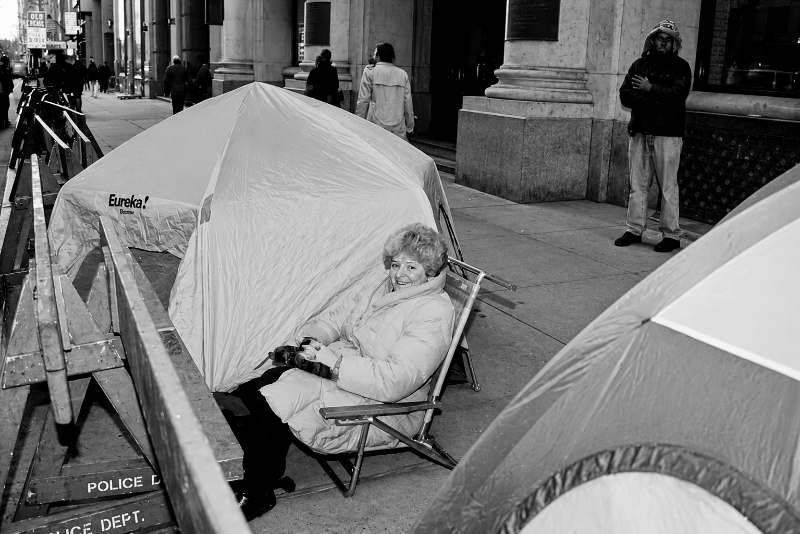
“Did you spend the whole night out here?” I asked.
“No, but my son did.” she answered. “He went to try to get an autograph from one of the players. I’m holding a spot for him “.
“I’m surprised the police let him pitch a tent here all night.”
“Well he knows the right people, I guess.“
“Did you stay out here also?”
“Oh no, I slept in the car. I parked in a parking lot not far from here where they have a security guard.”
I laughed. “I’ve never spent the night in a car before. Was it comfortable? Did you get a lot of sleep?”
She shrugged. “I got about 3 hours of sleep.”
“You must be diehard fans,” I said, shaking my head .
“Well, my son is. He’s thirty-two years old and he loves the Yankees.”
I chatted with her a bit more and took her picture before continuing on, running into the screaming fan again who looked hungover, dazed from lack of sleep, on drugs, or all three.
“I’ve been up since last night dude,” he blurted with heavy lidded eyes.” GO YANKEES!”
Before a conversation with him could start, I took his picture and moved on. Tour buses were abundant, as were police vehicles. At just after 7:00 a.m., the streets were not that crowded yet, and the cold was making my teeth chatter. I decided to stake out my spot from the McDonald’s across the street.
Inside, a mother was sitting at one table at the front window while her son was excitedly coming and going outside. Two elegant black women sat at another table watching the activity before heading to work. I set my gear down on the window ledge and began nursing a large coffee.
Sitting nearby was a fussy looking woman whose name I found out was Susan Sokol. She had short, grayish silver hair that was wrapped around her head, and the kind of gaunt face that suggested a long career in disapproval. She was thin and had on a long business trench coat. Her thin, small hands busily worked at the croissant and coffee before her.
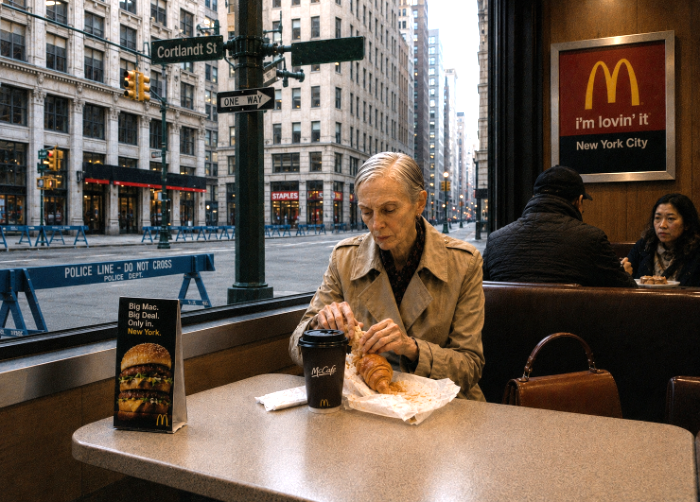
“It’s an imposition,” she complained. “They should have done this on the weekend when people didn’t have to go to work. I like baseball, but it’s not fair for those of us who have to work to put up with all this. I had to park over four blocks away, and it took me over two hours to get to work this morning.”
I asked her where she worked and she told me the World Trade Center, mentioning that she had been there the day of the explosion, the terrorist attack.
“What was that like?” I asked.
She shook her head. “It was undescribable. It was like a war zone, with all those trucks and the media and fire trucks. I’ll never forget it as long as I live.”
Outside the windows, occasional police vehicles and official trucks cruised up and down the empty street, which slowly was attracting more people on the sidewalk. A thin black woman on the sidewalk outside stopped at the window and held up a counterfeit Yankee T-shirt for the people inside. The mother asked in a loud voice how much; the vendor opened her hand twice; ten dollars.
How many do you have? the woman signed .
The vendor flashed her open palm several times, and after a moment’s consideration the mother signed that she would buy two for eight. The vendor nodded and the mother got up to go get them. The hand signals reminded me of the floor of the stock exchange where traders communicated by hand signals.
Continuing my conversation with Susan Sokol, I said, “Well I’m not a native New Yorker or anything but the Yankees are such an integral part of New York City’s identity. When they win the world series the city wants to celebrate. “
“Some of us still have jobs to get to.” Susan insisted. “Businesses don’t stop just because the Yankees won the World Series. I have a job. I shouldn’t have to deal with this.”
She finished her breakfast and we exchanged goodbyes. Outside, the street was beginning to become more crowded, so I headed back out. It was almost 8:00, and the parade did not begin until 11:30. I went and stood by the marble platform, placing my camera bag on top of it to hold my spot.
People were handing out free copies of the Daily News and selling team posters for fifty cents. A vendor with a backpack ccame by hawking baseball bat pens at five bucks a pop. At the corner of Cortland, an Eyewitness News 7 TV truck was parked with two guys setting up railings on the roof. A thirty foot high antenna assembly was topped by a TV camera and radar dish, a wire snaking around the pole. A police stake body truck cruised by carrying police golf carts. A small, three-wheel police scooter patrolled the barricades, stopping to tell people at the curb not to stick their feet out because of the traffic.
Suit-wearing security guards stood on the marble platform keeping people off, but by the time the parade would begin, there would be so many people they would not be able to do that, so for now, I let my camera bag occupy the spot for me.
A middle-aged man wearing a Yankees jacket wandered over and stood beside me. He was shorter, with square rimmed glasses and two deep lines of age spreading from his nose. His cheeks had begun their sag, and he had a barely noticeable trace of hair on his upper lip. He looked like a child’s favorite grandfather with a whiff of mob connections.

“I tried to convince my son to let his daughter come with me today.” he said in a raspy, understated voice. He shook his head. “He wouldn’t let her. This kind of thing doesn’t happen every year, I told him but he wouldn’t listen. She’s got school he says. Oh well, what c’n you do, ya know?”
I nodded. The school chancellor had the unenviable job of insisting that schools stay open during the parade. Still, one in three students would be absent, as it would later turn out.
As if to underscore the point, a group of children were running around the plaza, screaming and laughing, having a grand old time. One of them was about eight or nine wearing a white Yankees t-shirt that reached her knees, and a Yankees ball cap on a large head of black hair. She had soft, caramel colored skin and eyes that sparkled with life and happiness. Her parents were camped out at the corner, and when the kids retreated to the blanket there, I went over, seeing a good picture.
“Hey, can I take your picture?” I called.
The children bunched together, mugging for the camera, cheering. “Say Yankees!” I said, and took a few pictures. The parents were laughing as I thanked them and went back to my spot.
There was a festive joy in the air. Even taxi cabs were stopping between intersections to let pedestrians cross. People walked by wearing Yankees paraphernalia, laughing and talking. The little girl with the oversized Yankees t-shirt went up with her friends, standing on top of the marble.
“You might be famous,” I told her. “Your picture might appear in a local paper where I live.”
“Yeah!” she cheered. After a moment’s consideration she said, ” Can I have that picture?”
I smiled “Sure. I need your address.”
The girl jumped down running towards her parents. ” Mommy! I need our address! ” I had to wait only a couple minutes before she came racing back breathlessly. “473 West End Avenue, Manhattan!”
“Okay, what’s your name?”
“Emily Calcano!”
I wrote it all down. “Okay Emily, when I get the pictures back, I’ll send you a copy. It was nice meeting you!”
Emily dashed off, screaming excitedly, and I couldn’t help but grin at having made a child’s day even brighter than it already was.

Slowly, the sidewalks began to get more crowded. From one person deep at the barricades, it became two, and then three people deep. The old guy beside me was named Joseph Rocco, and we chatted as we waited. I took his picture and he insisted on giving me five bucks to send him an enlargement. On the other side of me was a calm looking guy dressed business casual with a grayish beard who had turned out to catch the parade. He was talking to people on his cell phone. In the windows above, people were beginning to appear, some hanging out homemade banners. Joseph handed me his binoculars, pointing out the good-looking ladies.
He had a good eye .
The crowds grew. The space between Joseph and I and the crowds at the barricade shrunk until people were squeezing by, some more politely than others .
“We’re New Yorkers, ” the man with the gray beard said mildly. ” We don’t care. We don’t say excuse me. “
“Right.” I answered with a grin. “It’s more like, get the fuck out of the way!”
He nodded. “That’s it. We don’t care.”
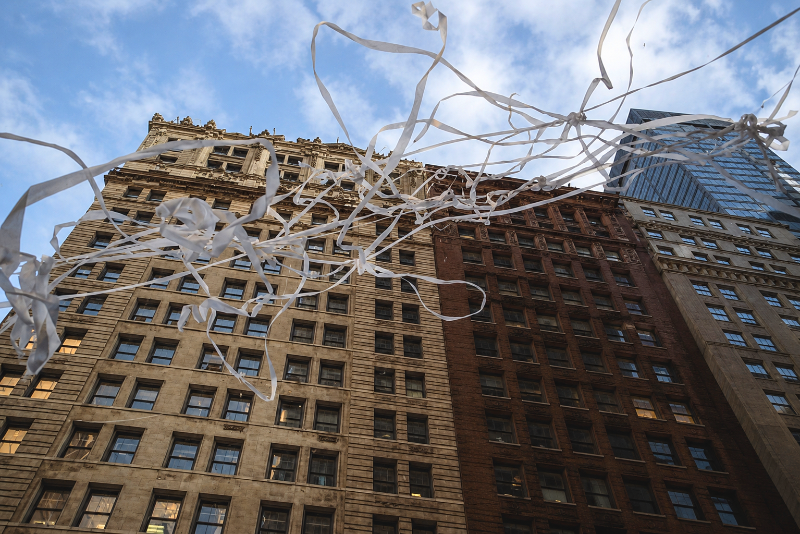
People were tossing rolls of toilet paper up into the air, across the street, and booing when it didn’t leave a floating trail of white gauze. Confetti and shredded paper were already beginning to float down like a hesitant snow storm. The sidewalk was a mess of newspaper and stationary. Toilet paper was draped on the street signs and lampposts like New Year’s Eve streamers and fluttered peacefully in the breeze. A nearly solid line of police kept the sea of people behind the barricades. As the tour buses and delivery trucks drove through, the crowd cheered and roared boisterously.

The suit-wearing guards who stood on the three marble platforms to keep people off had given up, so I took the opportunity to climb onto the marble platform, helping Joseph so he could stand beside me, and now it was covered with people. Everywhere I looked there were people. Below me, a black man was escorting his son through the crowds, saying, “Don’t look at me. It’s not my fault if you and your mother fell asleep when they won.”
People in the offices were leaning out of the windows and sitting on the ledges, some holding handmade banners. One of them was not spelled correctly because a portion of the crowd began chanting, “YOU-CAN’T-SPELL!”
The woman holding it leaned forward, inspected the sign and after a few minutes pulled it back into the building, eliciting a raucous cheer from the crowd.
The energy and noise continued building. The crowd alternated between singing Take Me Out To the Ballgame to cheering WAY TO GO YANKEES, WAY-TO-GO!.
Looking up at the narrow river of sky between the building tops, I felt like I was in a snow globe. Bits of paper and streams of gauzy toilet paper floated and swirled around, in no hurry to reach the ground. People covered every horizontal surface, including the huge girder lining the base of the building behind me, over ten feet above the steps that led to the entrance beneath. Their legs dangled over the edge like the old pictures of the construction workers eating lunch on a girder high above the city.
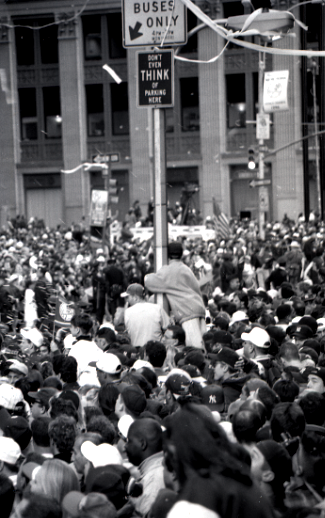
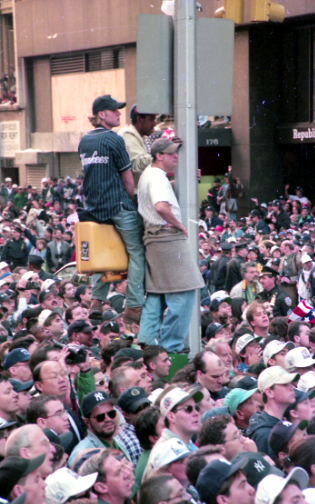
A police officer on a horse trotted up the street, producing another cheer from the masses. The New York Times the next day would write that “lower Manhattan groaned under the weight of a crowd that Mayor Rudolph W Giuliani put at 3.5 million, an estimate probably born more out of enthusiasm than precise methodology.”
Finally, the parade became visible, inching up Broadway, beginning with a police car with its blue lights splashing color.
“Is that it?” the gray bearded man asked me from below, where he stood on the sidewalk.
“Looks like it,” I called down to him. Beside me, Joe called out, “GO YANKEES!” in a raspy voice nowhere near loud enough to be heard above the din. Graybeard handed me his camcorder and I panned the street and buildings, getting some good footage for him. I had both cameras around my neck, and my disposable panorama camera in the cargo pocket of my safari jacket.
Down the street inched the huge inflatable glove and baseball, moving slowly through the jammed river of people. A near blizzard of paper, stationary and toilet paper filled the air. The roar of the people was near deafening, a surging, physical force. People on the marble island around me jockeyed for space while below, parents guided their kids through the throngs, fruitlessly looking for good views.
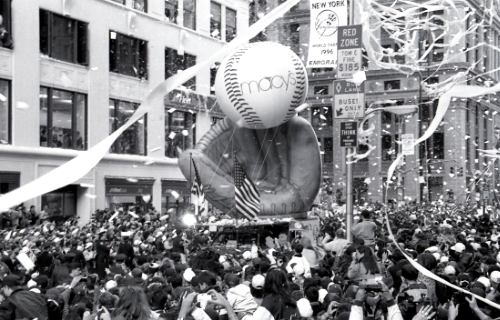
The next float contained the Rockettes, dressed in green Christmas elf outfits, eliciting some wolf whistles. As the players came through on their floats, with their names on the side, they seemed overwhelmed by the turnout and energy. One fan in the crowd hoisted a huge python above his head as the floats passed. The players and wives gaped and pointed, mouthing oh my god!
I alternated cameras as the floats came through, switching between color and black and white. Next came a string of classic cars: a Rolls-Royce Silver Shadow four-door, painted white with blue stripes with a Yankees logo on the sides, and a convertible which contained city officials, including the ethically challenged state senator Al D’Amato, Joe DiMaggio, and the governor in the back seat. One was a city-owned 1952 Chrysler Phaeton, worth more than $350,000. Only five of them were ever built and only three now exist. The city’s Phaeton, a black convertible, had been found years ago covered in soot in the corner of a sanitation department garage.
My fingers were tingling as feeling in them began making an exit. I concentrated on shooting the floats as they continued to crawl through the narrow lane bordered by wall-to-wall people. In between the floats were press photographers and TV camera crews who occasionally panned their cameras at the crowds, who screamed and jumped and flailed their arms in spasms of enthusiasm. On the corner, atop the TV news van, the anchorman stood on the roof in front of the camera, a microphone in his gloved hand broadcasting the parade live (to see this broadcast of the parade, click HERE).
I took some more footage for Gray Beard as a procession of floats and vehicles moved forward inch by inch. The Yankees stadium groundskeepers float came through, followed by a police and fire department band, a double decker sightseeing bus and an antique fire truck, followed by a high school marching band. This signaled the end of the parade, and at this point the crowd began to break up and disperse, flooding the empty space where the parade had been. A large cluster of people flowed north, following the parade to City Hall while others lingered to scoop up the piles of paper, throwing them into the air.
Joseph climbed down from the marble pedestal and looked up at me. “You comin’ down?”
“No, I want to stay up here a bit longer and shoot some more pictures.”
“Hey it was nice to meetchya,” Joseph said, extending a vein covered hand. I squatted and shook it firmly.
“The pleasure was all mine, Joseph.” People swarmed around us and shouts and cheers filled the air. “When I get the pictures processed I’ll send you a nice one. I’ll call you.”
I watched Joseph wander away, merging with the people, and after taking a few more pictures I jumped down, slinging my camera bag over my shoulder and merging with the crowds myself.
The street was awash in paper; the asphalt was completely covered. People were running around throwing paper at each other. Others were posing in the drifts for pictures taken by the companions. With ticker tape nonexistent, everything from express delivery envelopes to entire boxes of unshredded, confidential records had been hurled out of windows. In fact, the New York Times would report that checks issued by the city housing authority and records of unemployment checks from the department of social services had been tossed. That night, comedian David Letterman would joke that New York City honors its heroes by throwing trash on them.
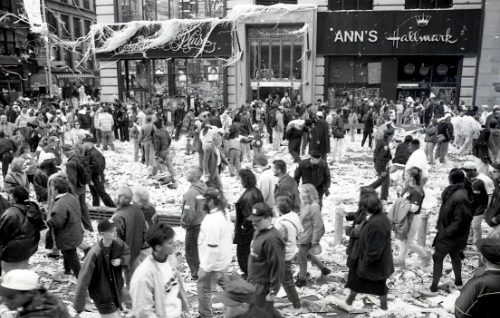
The air was filled with post parade glee. People were dancing, chasing each other and engaging in guerilla paper fights. The police immediately closed down Broadway starting at Cortland, and crowds of people massed at the barricades like blood clotting at a flesh wound. I found myself jostled and squeezed as I tried to exit Broadway. Since the police were trying to minimize the number of people making it to City Hall, I squeezed through the crowds, ducking down the darkened canyon of Courtland toward Nassau Street.
The tall buildings rose high on all sides, blocking the sun above, plunging the street in perpetual shadows. Paper was everywhere; I shuffled through it like autumn leaves. More police at the northbound Nassau Street; they had blocked crowds there as well. I was hungry, and my fingers continued to feel like ginger ale.
Little did I know that this day would not be over by a long shot. I still had some obstacles in store before I would finally make it home, late that night.
I decided to head for the South Street Seaport. It was touristy as hell, but at least I would be able to grab some chow from the food court. By now, a small number of police officers were returning to find their cruisers smashed up, having served as a platform for parade spectators. I passed a lanky, black maintenance employee who stood in front of his building with a large broom, laughing. “To hell with this,” he said to no one in particular, surveying the street filled with paper. “I’m not even going to try!”
I could understand his point.
The sun was brilliant and warm as I ate on the open patio of the food court at the South Street Seaport, with multi-masted schooners moored at the piers. Umbrella covered tables dotted the wooden deck in front of the large building, a complex of shops and cafes. I stretched on the wooden bench and let the sun warm my face. The broad deck around me was filled with tourists of all nationalities, lying on deck chairs, sitting on the floor in groups and eating and drinking. The air was cloudless and helicopters buzzed the sky. The day was so perfect it needed a copyright symbol in the corner somewhere.
Even though I felt like falling asleep in the sun, I suited up and headed out. I needed to find a way home, and lower Manhattan would be difficult to navigate in the wake of the parade.
In the crowded bar at the food court, people were watching the rally currently taking place at City Hall. Wade Boggs, the Yankees’ third baseman, stood beside the police commissioner. He was already a legendary player by then, a former Boston Red Sox star who had joined the Yankees a few years earlier. The commissioner was giving him a certificate making him an honorary policeman, as well as a police helmet. Boggs had ridden around Yankee Stadium on a police horse, after the final out that had decided the game. People had run out onto the field, and the Yankees themselves had formed a huge pig pile, with one player jumping onto it and rolling off the other side.
“I’m so proud to be a Yankee,” Boggs said, stepping up to the microphone, holding the certificate. “But most of all I’m also so proud of you fans. You talk about the greatest spectacle in the history of sports. This ticker tape parade was the greatest spectacle in history.” The crowd in City Hall and at the bar cheered enthusiastically and clapped.
At the rally, Mayor Giuliani was presenting each player with a key to the city, and officially declaring today New York Yankee day. I didn’t stick around to watch the rest of the rally. I wanted to get back out to the street and find a way home.
The cobblestone Fulton Street was crowded with tourists and New Yorkers alike, basking in post-parade euphoria. Even here, blocks from Broadway, paper littered the street like a blizzard of leaves. At Broadway, large city bucket loaders with giant horizontal opening claws were scooping up paper from the street and loading them into trash trucks. Further up at City Hall Park, people were everywhere, milling around while loud speakers blared, as the rally was still in progress. Police officers were present in huge numbers.
It was a mess. Paper strewn everywhere, bushes trampled, people standing around smoking cigarettes, a New York version of Woodstock. A vendor was selling hot dogs. A man stood on an up-ended trash can, a pair of binoculars glued to his eyes. Police and police cadets were encamped like an invading army, standing around cruisers, paddy wagons and police vans. Barricades fenced off City Hall as I moved through the crowd of onlookers, moving around the rally, walking along Park Row lined with dozens of blue and white police cars and vans.
So how was I going to get back to Grand Central?
The transit authority ran sixteen more trains than normal, enough to carry 30,000 people at a time. As it turned out, most of them would be packed and some would even speed by their station simply because there was no room on the platforms to unload passengers. Joseph E Hoffman, senior vice president in charge of subways, would later comment, “I’ve never seen this many people in my life and I can’t believe how well everybody behaved.”
I made it back to Broadway north of the festivities, where it was calmer, and headed north, not really sure what to do now, but deciding I wasn’t ready to go home yet. The open expanse of the twin towers plaza was lightly populated with people who seemed in no hurry to get anywhere. The huge, round fountain with its sculpted sphere and water cascading over the edge of the fountain had only three or four visitors. I drifted into the base of the North Tower; it was something to do.
The high ceiling of the North Tower lobby created an open, airy feel. The broad atrium was sparsely populated, and was ringed with a wrap-around balcony on the next level up. After buying a ticket I allowed a guard to search my camera bag. After the World Trade Center bombing, we have come to expect changes as the price to pay for security.
The line at the elevator moved quickly and it was not long before we reached the 107th floor, 1,310 feet above the street in only a couple of minutes. I was still inside the building. The panoramic vista was interrupted by the vertical columns that made up the sides of the North Tower. One could step down into a lower section that ran along the windows in order to get the best view while above, video terminals offered multi-language information on points of interest. The broad corridor was sparsely populated and people were strolling around in a leisurely manner.
I had to walk the perimeter of the floor to get to the escalator that led to the roof. It took me up to a revolving door, beyond which was another escalator and a staircase that led to the observation deck of the Twin Towers.
What a view.
It felt like I was on top of the world. The horizon stretched out in all directions and I could almost see the curvature of the earth. Like a sprawling architect’s model, the buildings of New York City and New Jersey stretched out around me, the converging Hudson and East Rivers a twinkling blue mat, reflecting the light of the setting sun.
The observation deck formed a square atop the tower with a high fence below, topped with barbed wire to prevent people from getting close to the edge. The Brooklyn and Manhattan Bridges were already in shadow. The other tower loomed not even a stone’s throw away, basking in the orange light of the setting sun, giving its silvery sides a warm cast. The sky around me was alive with the blinking lights of helicopters and planes making their approach to JFK airport. A small Cessna plane cruised by right at roof level, so closely I could have hit it with a well aimed stone.
The light was rapidly withdrawing from the sky, the sun trying to be remembered. Across the mouth of the Hudson River was a large illuminated analog clock that said COLGATE. Beyond, the last rays of the sun created a bruise colored zone of purple pink that covered the horizon like a blanket. I was watching the sun go down from the top of the world.
After the last light finally vacated the deep blue of the evening, I headed down towards the elevator and back to ground level.
The sultry, moody beat of This City Never Sleeps by the Eurythmics was my soundtrack as I walked the urban jungle of concrete and steel heading north. The World Trade Center towered high overhead, rising up into the night sky, hundreds of tiny lights indicating people still at work. I began walking up Church Street, passing the darkly upscale Millennium Hotel. Lincoln Town Cars and limousines were parked in front with uniformed attendants loading and unloading luggage. Taxis screamed by and in the distance somewhere a siren was crying out. Blue police barricades sat clustered on the sidewalks, no longer in use. Paper clogged the gutters and lay strewn over sidewalks and further up I could see a street sweeper trundling along like a huge mechanical beetle. Manhole covers were emitting clouds of steam into the night, backlit by car headlights as they raced through the clouds. At a corner, a miserable looking black guy wearing an orange traffic vest that said WIGGLES on it was handing out leaflets for a topless bar not far away.
I kept walking, immersed in the music, perfect for a solitary stranger walking through a not entirely friendly dark city at night. A big blue and white police stake body truck was moving along the curb, its back filled with blue sawhorses. Two flannel shirted people were disassembling them and throwing them into the back. Darkness lurked in the alcoves and crevices of the old buildings around me, car headlights and lighted signs advertising food and spirits. Blank-faced strangers passed by wordlessly. Battered news boxes for free real estate and classified ad papers sat sullenly on street corners, their insides empty.
Up ahead was the entrance to a subway station, its stairs leading down and, at long last, to a way home after a long day .
Or so I thought.
When I stepped out of the train and onto the platform of the station, I didn’t even look at the name of the station, so sure I was that I had reached Grand Central. I had stopped at a bar before hitting the subway to have a single beer which tasted like liquid magic. I went through the prison-like one-way revolving door, and trudged up the steps behind a middle-aged couple having a casual conversation about their children and how they can’t cook. I was tired, and looking forward to that Metro-North train back to Port Chester and home.
Dimly I wondered why the stairs of the station led to the outdoors? It should lead to the Grand Concourse of Grand Central .
I reached the top of the stairs and froze.
I was not at Grand Central. Not only was I not anywhere near the Grand Concourse, but there were no speeding taxicabs and crowded sidewalks. Instead, I was at a four-way intersection completely devoid of people, lit by a single street lamp. Townhouses lined crumbling, shabby sidewalks. There was no sound.
I felt a bit like Vic Morrow in The Twilight Zone movie. Where the hell was I?
I walked to the corner. The night was as still as weak beer, and there wasn’t a car or person in sight. The streets leading away from the intersection grew darker, and in case the scene was not dramatic enough, there was a destroyed New York City police car parked halfway on the sidewalk, its front corner completely demolished. It was something you would see in a post-apocalyptic movie.
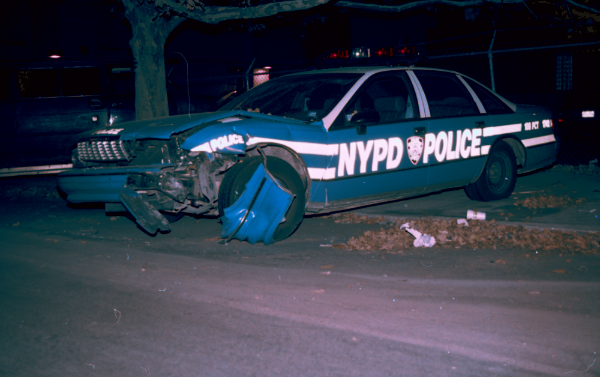
I wandered around the entire block, expecting to see Grand Central or the Chrysler Building at any moment. Instead, I found myself in a neighborhood with abandoned buildings and abundant destitution, a place where the local thugs needed bodyguards. Way off in the distance, rising above the skyline was the Chrysler and Empire State buildings. It was obvious I was far from my intended destination. Somewhere in the distance, unseen by me, Rod Serling was standing, hands clasped before him, cigarette between his fingers, lecturing the audience about the perils of a man who was a bit too confident for his own good.
I emerged from the darkness into a glaring, yellowish light that illuminated the intersection like an improv stage. A young, casually dressed couple was walking in my direction, and I hailed them and explained that I was trying to get to Grand Central. They laughed, an understanding, sympathetic, I’ve-done-the-same-thing-myself type of laugh.
“Well this is Queens,” the man said. He was in his twenties with a boyish face and innocent eyes. He was wearing new looking trousers, brown lace shoes and a loose fitting plaid flannel shirt. His female companion was a demure, shy looking woman with long straight hair, dressed in a similar fashion. The three of us stood under the bright sickly yellow street light on the empty street, like players on an empty stage performing a scene.
“Queens!” I exclaimed, laughing. “So not only did I get off on the wrong stop, I’m not even on the right side of the river.” The three of us laughed together on cue. “How do I get back to Grand Central?”
The kid gave me a short set of directions, as I had totally lost my bearings. I thanked him for helping me out.
“You want to be careful,” the kid said in a soft voice, “walking around with all that camera gear. This is not a good neighborhood.”
“I kind of gathered that when I saw the destroyed police car. I was in Manhattan shooting pictures of the parade, and I’m pretty tired and I guess I had a little trouble deciphering a subway system.”
“You were at the parade?” the woman piped up with an interested smile. “What was it like? I wanted to go.”
I smiled back. “It was wall to wall bodies. You couldn’t even move and the noise was deafening. There was paper and toilet paper falling down like a blizzard.”
I thanked them again and headed off to find the subway station. I reached the intersection but could see no indication of it. Was someone moving the streets around on me?
As I stood there trying to decide my next move, who should come walking back toward me but the couple who I had just asked for directions.
“Fancy meeting you again so soon,” I said and the girl laughed, shyly amused at the situation.
The kid told me that I had been going the wrong way, and that he wanted to make sure I found it. We fell in step together, laughing about the episode and we finally reached the subway station with its green glowing globes at the head of the stairs. I thanked my guardian angels and bid them a warm farewell and a good night and headed down.
Now I can say I’ve been to Queens.