Moving day
Sunday, March 1, 1998.
The corner of Forty-Second Street and Eighth Avenue was relatively quiet at the hour of seven-thirty a.m. on a Sunday. The rush-hour madness, the frantic, frenzied pace typical of New York City would not commence until tomorrow morning. Just about the only traffic, besides the ubiquitous yellow cabs, were Manhattanites making an early morning errand or putting in a couple of extra hours at the office for that important presentation tomorrow.
Which was just as well, for a maze of blue police barricades were sprinkled liberally around the busy intersection, with several cops diverting and directing the light traffic flow. Barricades lined the sidewalk of 42nd Street toward Times Square, and the parking lot on the corner of 42nd and Eighth Avenue had been converted into a spectator area.
There was an empty podium, plush seats for the politicians who would arrive later, and a large tent had been set up. The whole lot was fenced off from the public, who would have to watch from across the street. Looming ominously over the scene was the brutalist Port Authority complex.
The reason for the activity: the old Empire Theatre was being moved 168 feet west along 42nd Street, where it would become the lobby for a 25-screen megaplex movie theater. The 37,000-ton building had been hydraulically lifted from its foundation onto a temporary platform, which rested on eight steel rails.
Two-inch steel rollers allowed the platform to be moved by huge six-foot hydraulic cylinders that would push the platform and the theater to its new home. The entire operation would last about six hours, with the bill for the whole move being $1.23 million, or over $500 an inch.


When the theater was placed on its new foundation and renovated, it would be part of a huge complex of stores and businesses that would include the theater, HMV’s flagship music store, and the first Madame Tussaud’s wax museum to open in the United States at 60,000 square feet, along with small boutiques and theme restaurants.
The project was consistent with New York’s efforts to sanitize Times Square and turn it into a family-friendly utopia. Indeed, New York’s highest court had just ruled that Mayor Rudolph Giuliani’s efforts to scatter and thin out the sex businesses were legal, making the city safe from moral depravity.
After parking my Plymouth Laser on a side street, I walked the two blocks to where the action was. I was wearing jeans, sneakers, a safari shirt, and my photographer’s vest; over that, I wore my trusty army field jacket. I looked like a world weary war correspondent.
My Minolta X-700 was slung over my shoulder, awaiting the pictures it would take. It was my faithful sidekick, always ready, rain or shine. I had become attached to it in the years it had been with me, all over the world. The motor drive grip actually felt like an extension of my own hand: we had seen a lot together.
A light fog obscured the sky above the jungle of buildings as I reached the parking lot. Its entrance was narrow, allowing a couple of people at the front to keep the general public out.
I walked briskly up to a petite Asian woman wearing a severe blue suit behind a plastic table.
“Are you press?” she asked me.
“Freelance,” I answered.
She looked hesitant, so I continued, “I’m a freelance photographer for a small upstate paper.”
She didn’t seem convinced, but she didn’t seem comfortable with flatly refusing to let me in either.
“Talk to that guy over there,” she said.
I bypassed her, walking up to a long table with a white tablecloth where a smiling PR type was standing. In a rushed, very busy manner, I held out my hand.
“Mike Lyman, freelance photographer. Do you have someplace I need to sign in or something?” I acted as if I was way too busy to be delayed by anybody.
He nodded, beaming. “Sure! Sign in right here if you wouldn’t mind.”
I signed my name, put down the name of a fictitious newspaper and a fictitious work number, thanking him.
“Oh, don’t forget your press kit.”
He held out a blue packet grandly.
“Oh, thanks.”
I took the blue folder, folded it, and tucked it into the inner pocket of my photographer’s vest. I would look at it later.
I was in.
As any party crasher will tell you, the secret of being somewhere you don’t belong is to look and act as if you do. So while the general public would have to watch the proceedings from the sidewalk across the street, I was going to see it all from the VIP area.
Loudspeakers adorned with balloons were blasting show tunes. The podium, where the politicians would eventually make their speeches, was empty, as were the airplane-style theater seats set up at the sidelines. A huge clear tent had been set up near the back of the commandeered parking lot, and people milled around aimlessly.
The real show was up front.
Huge inflated balloons resembling Abbott and Costello stood on a platform on the rails over which the theater would travel, holding a yellow inflatable rope. They were positioned to look as if they were pulling the building, and looking very unhappy about it. People in hard hats walked around their huge round feet and around the theater itself. Photographers milled around snapping pictures.
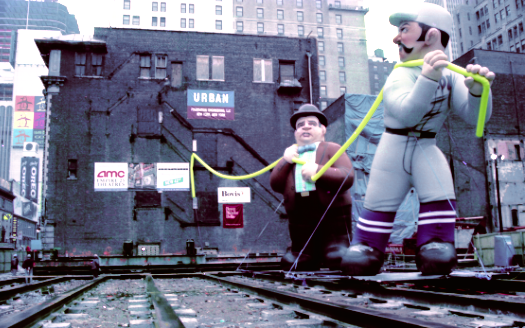
I walked up to the fence that guarded the steel rails, watching hard hats converse among themselves. A couple of them cranked a winch lever, which moved the balloons forward on its own platform. My first thought was that these ratchet winches were the force pulling the building forward, but of course that was impossible.
The Abbott and Costello balloons bobbed gently. They looked like frustrated giants being held captive by the tiny people around them.
The steel rollers on which the building sat were moving—but at such a slow rate it was impossible to see, like watching the moon travel across the night sky. Like some immense, snail-paced train, the Empire was being shoved, seemingly against its will, toward the waiting crowd.
The Empire State Building watched in the background, partially shrouded in fog.
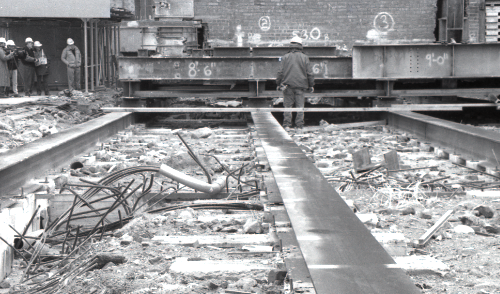

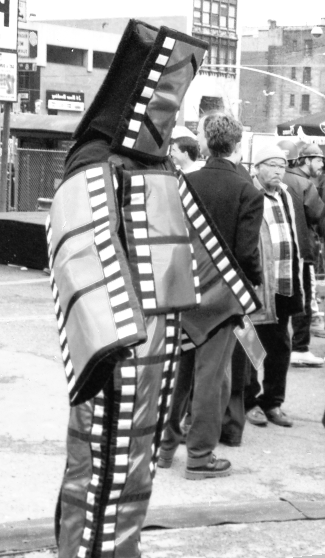
After shooting some initial pictures, I wandered around the parking lot. Besides the show tunes and festive balloons there was a guy wearing a film cannister costume. From across the street people were using binoculars to watch the proceedings from one of the Port Authority levels. Big screen televisions showed huge cylindrical pistons on the other side of the building. Those were aligned with each rail, nudging the platform forward millimeter by millimeter, while hard hats looking through survey equipment monitored the building to detect any shifting or tilting. The last thing anybody wanted was for the theater to collapse; the political fallout alone would be brutal.
It would almost be worth it.
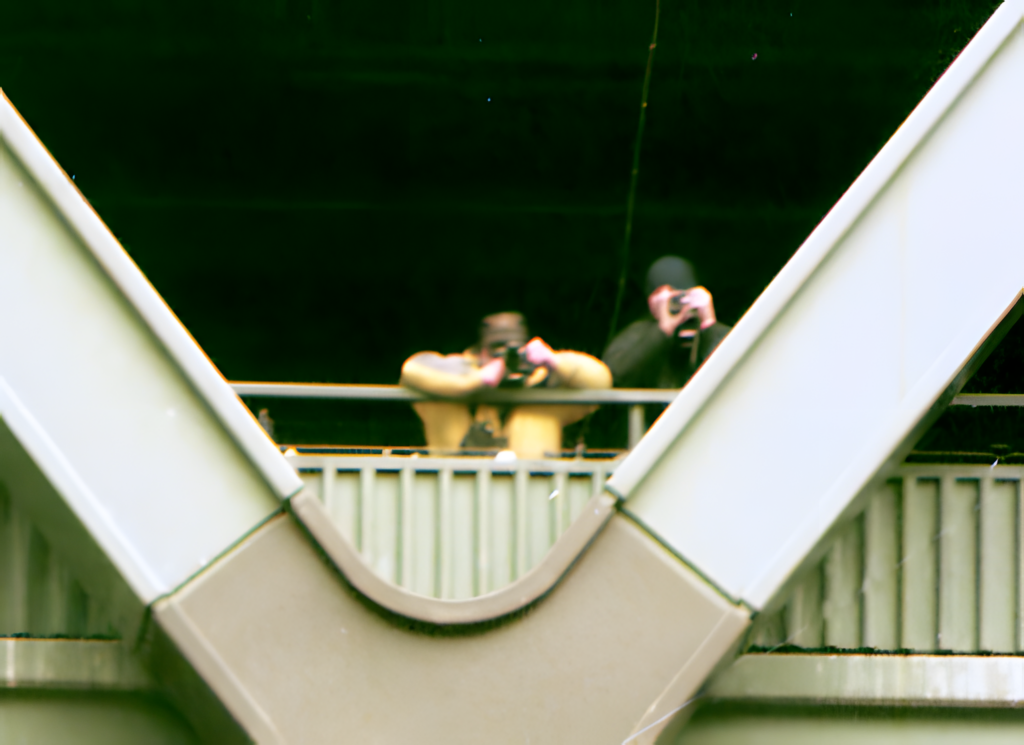
The morning was remarkably mild for March, but after a couple of hours I decided to go into the large tent to warm up. Across the street in the Port Authority complex, New Jersey Transit buses moved back and forth beyond the massive diagonal girders like ants preparing for a long winter.

Inside, the tent was cozy and warm, with a grass mat, café tables with red tablecloths, and umbrellas over them. There was a speaker in here as well; Abbott and Costello were launching into their “Who’s on First?” routine.
In the corner, a small group stared at the big screen TV showing the rear of the Empire. Where the public was not allowed, the huge tent was comfortably free from crowds. Good thing that people at the parking lot entrance were keeping out the general public; only us important media people should be allowed in.
At the rear of the tent was an elaborate assortment of fruits, juices, muffins, bagels, Danishes, and coffees being tended by red-vested servers. Those round gold urns of coffee looked mighty enticing; I had not had any breakfast this morning.
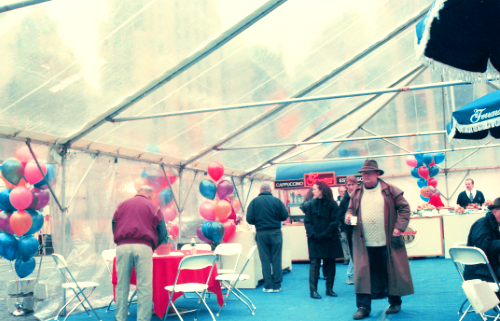
“How much is the coffee?” I asked one of the red vests, a cute petite brunette.
She blinked. “How much is the coffee? It’s free.”
Right, of course.
Feeling a little sheepish, I poured myself a cup, grabbed a nice-looking cinnamon muffin, and consumed them at one of the tables while watching the TV screen.
Free coffee and muffins, a press kit, and a ringside seat for a Manhattan spectacle. I allowed myself a moment of inner glee before heading out to watch the proceedings again.
“So are they moving this thing?”
I looked over as a police sergeant stepped up to the fence where I stood watching the hard hats bustle around importantly. He was tall and thin, with Hispanic features, his police hat pulled low over his eyebrows.
“It’s moving all the time. You just can’t see it. It’s like watching paint dry.”
He laughed—a streetwise laugh that contained an undercurrent of threat.
“That’s the second time today I’ve heard that,”
I grinned. “I heard one of the contractors say it.”
We watched the activity together, arms slung over the edge of the fence. It wasn’t often I chatted with a city cop. One had to be careful. Police brutality was a recurring problem, with a mayor who consistently fought independent review of the police and a civilian review board that lacked significant disciplinary powers.
“This whole place used to be filled with porno theaters,” the cop mused. “Seedy as hell—drug dealers, prostitutes, crack addicts.”
“When that 25-screen theater is built, the area is going to be pretty congested,” I said. “You’ll be writing a lot of tickets.”
He waved a hand dismissively. “I don’t write many tickets anymore. Except for taxi drivers.” He paused, then asked, “What else are they putting in here?”
“Besides the theater, a huge record store, Madame Tussaud’s wax museum, and a bunch of other shops.”
A tall, heavyset black man wearing tattered jeans, a vest, and a wool cap came up to us and asked our names. He had taken a picture of us talking. He was a photographer for the New York Post.
I wandered around some more before going into the tent for more coffee and another muffin.
The press kit included a photo of a model of the entire block when it would be finished. The theater would consist of a visually deafening collage of signs and movie advertisements, in keeping with the Times Square spirit. There was a self-aggrandizing statement from the governor’s office, as if he had a lot to do with the project, and giddy propaganda promoting the businesses moving in and the architectural firms involved. There was also a history of the Empire Theatre.
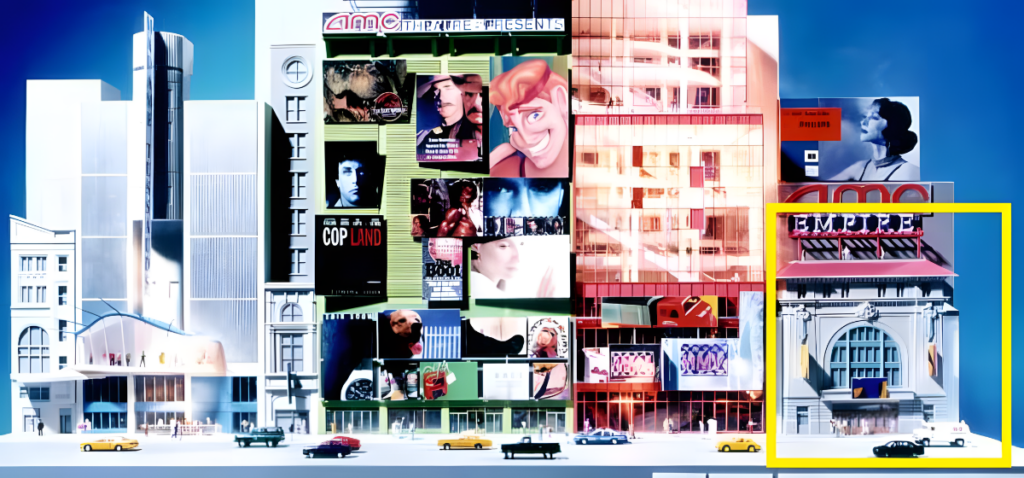
The 86-year-old theater, built by architect Thomas Lamb for producer-manager Al Woods, featured terra cotta ornaments on its Art Nouveau façade, along with Egyptian and Greco-Roman murals and motifs—elements that would later achieve fame in his lavishly designed movie palaces.
The first show at the Eltinge Theatre, its original name based on Woods’ biggest star, Julian Eltinge, was Within the Law, and it ran for a house record of 541 performances. With the Great Depression, however, Woods lost his beloved theater, and in 1931 it reopened as a burlesque house. It was in 1935 that Bud Abbott and Lou Costello, then working with other partners, teamed up for the first time—which explained the balloons.
Mayor Fiorello LaGuardia ended the Eltinge’s striptease days in ’42, when it was renamed The Laugh Movie and began playing Hollywood releases. In 1954, its name was changed to The Empire, and it played second-run feature films around the clock until it closed in the mid-80s.
The Disneyfication of Times Square made real estate prices soar as entertainment businesses flooded into the void left by porno theaters, strip joints, and adult bookstores. High-profile stores and restaurants renovated the buildings, more police patrolled the sidewalks, and now it was safe for families to take their kids through Times Square. At night, despite some opinions that the commercialized extravaganza had turned Times Square into a giant, glorified theme park, development continued—and continues—with the renovation of the Empire.
Even though I couldn’t actually see the building moving, Abbott and Costello had hauled it more than halfway to its destination. They were almost to the mesh fence surrounding the moving area.
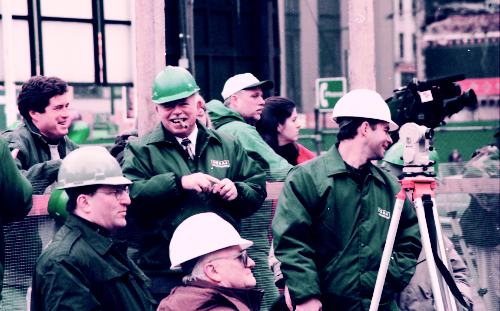
From the end of the rails, a group of contractors in blue windbreakers and hard hats congratulated themselves on a job well done. One older guy, who resembled Teddy Roosevelt, had a cigar corked into his grinning mouth beneath a thick graying mustache, boasting to a guy on the other side of the fence. Overlooking the whole spectacle was a giant, smoky-eyed brunette painted on the side of a building across the street promoting Camel cigarettes. Mysterious eyes studied the activity as she held a cigarette between two delicate fingers, legs crossed, leaning forward alluringly.
It was a vaguely surreal image. What could she be thinking about as she watched us tiny people go about our business?

The policeman I had been talking to began to move people away from the fence as the balloons and building grew closer. In the event of a collapse, the onlookers had to be a safe distance away. Yellow tape created a new barrier from behind which we watched as the Bud Abbott balloon neared the fence and was deflated in order to be re-inflated on the other side.

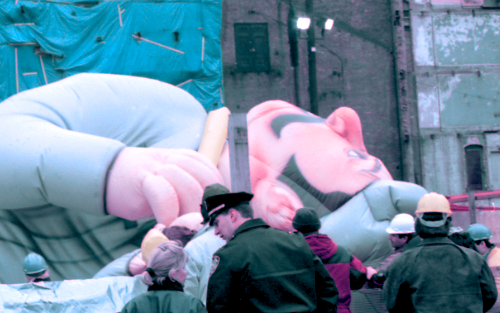
Like a mighty eighty-foot-tall gladiator felled in battle, Abbott tumbled to the ground, his sour expression looking up at the sky in defiance. Reduced to a misshapen lump, the hard hats gathered him up and hoisted him over the wire-mesh fence, covering him with a gray tarpaulin to protect the balloon. Once on the other side, the balloon was spread out on the asphalt.
I had some more coffee and a muffin in the tent before Abbott was quickly reinflated. I rushed out and snapped some photographs as the fallen giant arose from the dead.
Several workers pushed in Abbott’s face as he became filled with air, one eye glaring out at his tormentors. As he slowly rose above his captors, his arms and giant pink hands began to take shape.

Unrepentant, Bud Abbott the giant towered over the minions at his feet, holding on to the limp yellow tube he had used to pull the building forward. Crewmen held him at bay with blue straps attached to his side to keep him from getting away.
I chatted with a man in his sixties as we watched the procedure. Crowds had stopped along 42nd Street across the way, trying to get a good view of the action. Here I was, not fifteen feet away, with Abbott standing defiantly in the lot.
Glaring back at Lou, Costello was left to pull the building by himself. Slowly, his platform inched toward the finish line as the building grew closer. Looking grumpy and combative, he seemed to be staring across the street at the Port Authority, where several people watched from the third and fourth levels.
As the air was removed from his portly shape, his face became even more sinister—almost evil. His nose flattened and his face began to cave in against his bow tie. Only his glowering eyes peered out menacingly at us as his body began to collapse.
Finally, as if his neck were broken, his head rolled back against the ground—face contorted with pain, eyes searching out those who were to blame.
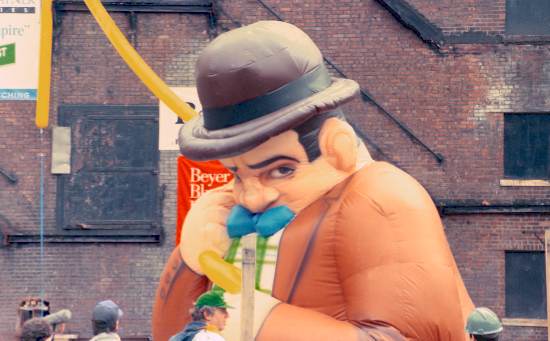
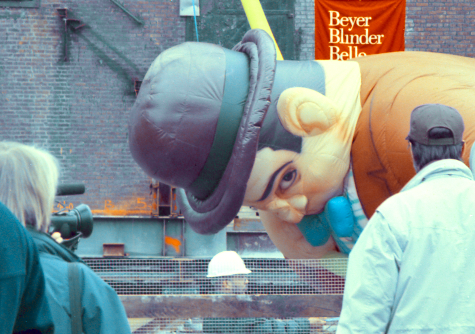
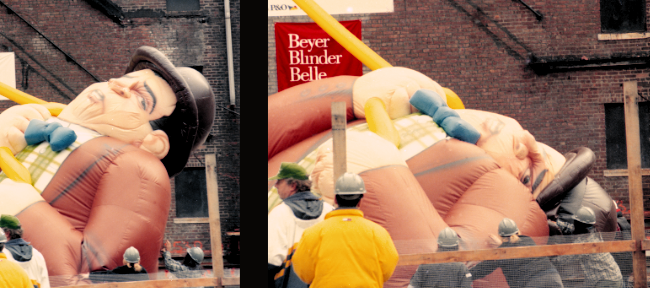
The hard hats watched as he, like Abbott, became a fluffy, misshapen lump of nylon. They gathered him up and brought him over the fence directly in front of where I stood behind the yellow tape.
The area was more crowded now, as photographers, contractors, architects, and city big shots gathered to watch. Crowds were forming along 8th Avenue and 42nd Street, attracted by the spectacle. The New York Times caption the next day would read: “Late-working New Yorkers discover 42nd Street has moved.”
The balloon crew dragged small sections of steel girders over to where Costello would be reinflated. These would be used to secure the straps attached to his side. Looming beyond all of this was the Art Deco Empire State Building.
Slowly, Lou began to take shape. His face lifted off the pavement and his eyes glared down at an indifferent balloon crewman who pushed his huge, deformed head up into the air.
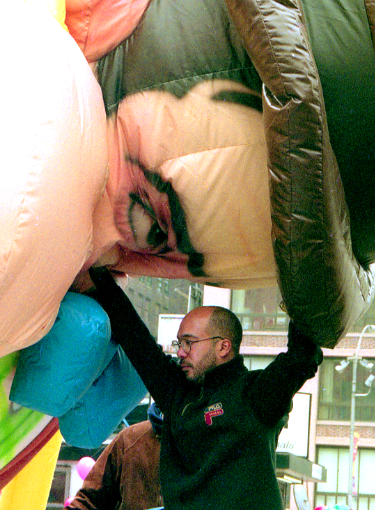
As Costello’s head began to grow, the crowd at the yellow tape found themselves staring up into his glaring, malevolent eyes, as if he were marking them as targets for his wrath. One small black child, wearing a hard hat two sizes too big, watched with an open mouth of astonishment as the balloon grew before him.


The scene was vaguely surreal as Costello continued to expand, his rotund bulk rising above the puny minions below him. As he rose to the height of his thinner companion, Lou Costello looked around ferociously. The yellow tape seemed like a fence containing these huge giants—not unlike the scene in King Kong where Kong is presented to the audience before he breaks free.
Should Abbott and Costello break free from their handlers, total pandemonium would result. No doubt they would rage through the streets of Manhattan while helicopter gunships circled overhead and police sirens screamed. People would run, screaming and yelling, from the two inflatable behemoths—some getting crushed and trampled in the madness, the huge rounded feet of Abbott and Costello crushing the dying bodies.
Come to think of it, that would be pretty cool… almost worth the resulting carnage.
The gentleman I talked to as we watched the spectacle was in his fifties, straight-laced, with a friendly face. He had lived in Manhattan for about fifteen years and had gotten up at six to watch the event, despite his wife saying he was crazy.
“How often do you see something like this?” he asked me.
“Not very often.”
He was an architectural engineer who had been involved in the construction of several buildings in Manhattan. He had a house out in the Hamptons where he kept his car, since the last two had been stolen.
“If you live in Manhattan, you don’t need a car anyway. The taxis are my limo service,” he explained with a grin.
As we chatted, a short, friendly-looking man came up to us. He had a nearly bald, round head and a face that was all curves. His eyes twinkled with glee, as if he had never frowned once in his life. He had a small, economical mouth, round cheeks, and a slightly stocky build.
“Excuse me, did I hear you say you came down from Westchester?” he asked, with a light, cheerful English accent.
I said I had.
“Are you a journalist?”
“Freelance photographer.”
“Oh, really! Would you mind answering a few questions on camera? I’m with the BBC, you see.”
I said I would be glad to and stepped over to where he had a small video camera sitting on a heavy-duty tripod. He slipped on a tiny pair of headphones and made some adjustments to the camera.
“So you’re with the BBC? I didn’t realize they had a bureau here. Is it Reuters?”
“Oh no, it’s actually a BBC office,” he explained jovially. “You’re probably thinking of the Reuters Business Information Office, which is here.”
He told me where to stand against the yellow tape, with Abbott and Costello behind me. Once he was set up, he held a large microphone in his hand.
“All right then—if you could, tell me what time you got up this morning, where you drove from, and why.” He held the microphone out to me, positively beaming.
“I got up at six this morning and drove down from Ossining, a town in Westchester County. I read about the building being moved in The New York Times, and I came down to photograph the event.”
“Is this kind of thing normal for New York?” my interviewer asked. I thought he might pop out of his skin with joy.
“Well, I would say it’s not too uncommon, because there’s always something interesting going on in Manhattan. It’s noteworthy enough, though, that I wanted to see it. I mean, how often do you see a building picked up and moved?”
“How long have you lived in New York?”
I shrugged. “About two years or so.”
“Do you like it?” His face radiated with childlike excitement. I hoped his heart wouldn’t burst.
“I love it. There’s always something going on down here every day.”
He lowered the microphone, smiling even more broadly—if that was possible. Apparently it was.
“All right then, thanks ever so much.”
“Where is this going to be shown?” I asked.
People crowded around us, drawn to the two tall balloons. Show tunes blared in the background.
“In England and parts of Europe,” the BBC man answered.
“Will it be shown over here?”
“No, mostly overseas.”
He finished putting the microphone and headphones away. “Thanks so much for your time. Cheers.”
He beamed, and I thanked him, merging back into the growing crowd.
The Empire Theatre was almost to its destination—a feat made possible not only by the engineers and architects, but also by that unstoppable force that makes it possible for buildings to be built, finished, and maintained: union workers. Pretty much every service-oriented job—whether it was a stevedore, doorman, bellboy, construction worker, or bus driver—was under the protection of a union. Unions were a New York institution, for better or worse.
It was almost eleven a.m. I had to get going if I was going to get to work at the camera store in Mount Kisco on time. The only thing I would miss would be the state and city big shots showing up in their limousines and Chevrolet Suburbans. There would be the governor trying to claim the project was a result of his innovative leadership—a claim as thin as the gold on a Las Vegas wedding ring. The mayor would give a speech, no doubt to be followed by officials of the Times Square Business Improvement District and executives of the firms involved in the project.
In other words, I wasn’t missing much.
I filed through the rapidly growing crowd toward the gate through which I had passed two and a half hours earlier. Two people stood at the entrance, preventing curious passersby from going in, saying that access was restricted to authorized people only.
I was one of those authorized people, because of course I was.
I left the parking lot and headed along Eighth Avenue, passing the fire trucks and a semi-trailer truck with “Collapse Rescue” on its side, ready in case anything should go wrong. People were massing along Forty-Second Street, trying to get a glimpse of what was going on.
I shoved my hands into the pockets of my field jacket and headed back to the car.
One week later, New York City would be back to its daily grind.
*************
On the corner of Eighth and Forty-Second, March 5, 1998.
The Empire, still dilapidated and forlorn, sat in its new home beside the parking lot, which was once again filled with cars. The podium, balloons, Abbott and Costello, and tent were gone.
The rush of cars—the raw, frenzied energy typical of a weekday—was back in full force.
In the ruins where the Empire once stood, a huge Sanyo backhoe scooped dirt into the bucket of a dump truck that had backed into the lot, fenced off and guarded by a couple of security people. Concrete barricades along 42nd Street sandwiched pedestrians between tall wooden walls defining the Empire’s old location and the coursing flow of traffic.
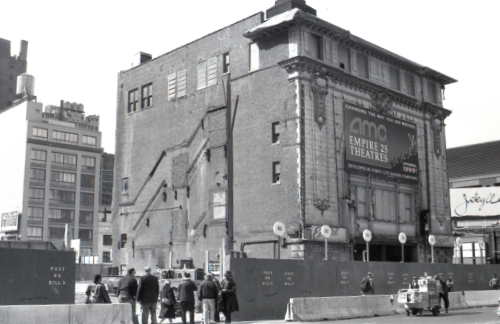
Across the street, on the other side of Forty-Second, a huge, nearly block-long crater about eighty feet deep was walled off in a similar fashion. Bucket loaders and dump trucks sat toy-like on the bottom, surrounded by busy hard hats. A tall sign towering over the sidewalk proclaimed this to be the future site of a multi-screen movie theater.
In essence, there would be two multiplexes across the street from each other. Ridiculous overkill anywhere else, normal for New York City.
I snapped a few pictures of the Empire, then turned and headed for the 42nd Street subway station.
I had another destination, and a train to take me there.